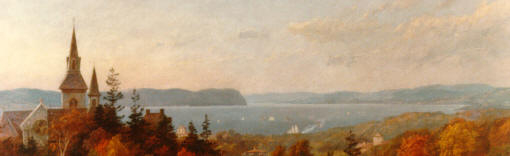
--Detail from 'View from Misses Masters School' by J. C. Cropsey, c.1890--Detail from 'View from Misses Masters School' by J. C. Cropsey, c.1890
Jack loved history so...No one will ever know everything about Jack.  But history made Jack what he was ... this little boy, sick so much of the time, reading in bed, reading history ...for Jack history was full of heroes. Jacqueline Kennedy Onassis

History is philosophy, teaching by examples. Thucydides 

I view it as a noble undertaking to rescue from oblivion those who deserve to be eternally remembered. Pliny


Village Historian of Dobbs Ferry

Video Interview with David Hackett Fischer
May 22, 2009, at Brandeis University

Noted Historians Reveal Dobbs Ferry's Historic River Connections
Part I
The 1781 encampment of the allied American and French armies
at Dobbs Ferry, Ardsley, Hartsdale, Edgemont and White Plains

Scroll down for Part II

The Era of the Revolutionary War
The American Cause

 These interviews have been made possible through a grant awarded to the Dobbs Ferry Historical Society by the New York Council for the Humanities

The Era of the Revolutionary War
The American Cause

WELCOME...

Thank you for visiting this website. To learn about Dobbs Ferry's remarkable history, please consider the following options:

Persons who wish to conduct in-depth scholarly research regarding Dobbs Ferry's history are invited to schedule a visit to the archives of the Dobbs Ferry Historical Society, which is located at the Mead House, 12 Elm Street-- telephone: (914-) 674-1007. These archives contain an extensive collection of historic documents, correspondence, artifacts and maps, historical publications, books, paintings, films and oral history recordings relating to Dobbs Ferry. The historical society also publishes The Ferryman, a lively and attractive historical newsletter, which appears quarterly. Please see the website of the Dobbs Ferry Historical Society for  additional guidance on ways to search for historical information about our village.

Historic Treasures of Westchester County is an initiative of "Virtual Archives," a collaborative effort of the Westchester County Archives and The Westchester County Historical Society. Access their web page, Historic Treasures of Westchester County , for a beautiful display of historical material from many of Westchester's towns and villages. On the web page relating to Dobbs Ferry, you will find exceptional picture postcards and other pictorial artifacts from the late 19th and early 20th centuries. 

Dobbs Ferry and neighboring localities played a vital role during the Revolutionary War and are important sites on the Washington-Rochambeau Revolutionary Route (W3R). Early in 2009, Congress passed legislation to establish the W-R Revolutionary Route as the Washington-Rochambeau National Historic Trail, and the legislation was signed by the president on March 30, 2009. Information about the role of Dobbs Ferry during the Revolutionary War is posted on the web site of the National W3R Association.

The website which you are currently visiting includes a pictorial account of the 1781 encampment of the allied American and French armies in Dobbs Ferry, Ardsley, Hartsdale and Edgemont. The strategic decisions made at the encampment in mid-August, 1781, led to a dramatic turnaround in the military fortunes of the United States at the Battle of Yorktown, in Virginia, two months later, to the end of the Revolutionary War and to remarkably favorable peace terms for our country.

Additional sections on this website include:
The historic maps web page
and
The notable quotations web page, which contains passages from articles and books which describe Dobbs Ferry of yesteryear.

Please feel free to contact me. I welcome your observations and feedback.

Richard Borkow, M.D.

Village Historian of Dobbs Ferry
Trustee, Dobbs Ferry Historical Society

January, 2008

NOTES ON AUGUST 1, 2008, SCARSDALE INQUIRER ARTICLE REGARDING DOBBS FERRY'S REVOLUTIONARY WAR HISTORY

SOURCE 1--Louis-Alexandre Berthier's map of the New York City/Westchester County region in 1781 (Library of Congress website):

The portion of the map which shows the encampment of the allied American and French armies in the Dobbs Ferry, Ardsley, Hartsdale, Edgemont and White Plains area can be easily located by using the "Zoom tool" and the "Navigation tool" of this Library of Congress map. The encampment portion of the map is also reproduced on page 1 of our April 26, 2007, U.S. Senate testimony. (The testimony can be found in the "NPS Recognition" section of this website; click on the "NPS Recognition" tab, above.)

On the Berthier map, two American units are shown as deployed in Dobbs Ferry, a light infantry unit (commanded by Col. Alexander Scammel) and a light dragoons unit (commanded by Col. Elisha Sheldon).

Scammel's unit was encamped at location 6 on Berthier's map, and Sheldon’s at location 7. Both position 6 and position 7 are, beyond any dispute, located within the present-day boundaries of Dobbs Ferry.

SOURCE 2 - Dr. Robert Selig’s 2001 study, THE WASHINGTON - ROCHAMBEAU REVOLUTIONARY ROUTE IN THE STATE OF NEW YORK, 1781-1782

This is the link to Dr. Selig's 2001 study:

SOURCE 3 - James Thacher’s Military Journal of the American Revolution (a primary source):

This is the link to Dr. Thacher's Military Journal of the American Revolution:

http://www.americanrevolution.org/t1781.html

Scroll down to Dr. Thacher's August 20 entry.

Dobbs Ferry’s three-year appeal to the National Park Service (NPS) for historically accurate recognition on the proposed Washington-Rochambeau National Historic Trail has been discussed in articles that have appeared in the Journal News (July 12, 2008) the Rivertowns Enterprise (July 25, 2008) and the Scarsdale Inquirer (August 1, 2008).

Several questions that were raised in these articles, and highlighted in the Inquirer article will be discussed below.

The discussants in the Scarsdale Inquirer article (Local Historians Debate Role of Dobbs in Revolution) asked whether the statement that Dobbs Ferry was the starting point of Washington’s 1781 march is a new historical claim. 

Actually, it is not a new historic claim. Dobbs Ferry has long been recognized by historians as the starting point of Washington’s march. An NPS map, prepared in 2001 for the American Revolution at a Glance project, conspicuously shows Dobbs Ferry as the starting point of Washington’s 1781 march to Virginia. That map appeared on the front page on the Journal News on July 12, 2008, and it demonstrates that we are not making a new claim; rather, we are attempting to prevent erasure, in NPS historical narratives and on Washington–Rochambeau National Historic Trail maps, of Dobbs Ferry’s very well-substantiated history.

Other topics mentioned in Local Historians Debate Role of Dobbs in Revolution are best addressed with documentary evidence. Three topics in particular will be of great interest to the discussants who were quoted in the article: (1) What evidence confirms that Dobbs Ferry was part of the 1781 encampment of the allied American and French armies?

(2)  What evidence confirms that American troops were paraded for the march on August 19, 1781, the day they set out for Virginia? (3) What evidence confirms that 2,000 or more troops marched in Dobbs Ferry on August 19, 1781?

To answer these questions, let us examine both primary sources and modern historical scholarship. 

1. What evidence confirms that Dobbs Ferry part of the 1781 encampment of the allied American and French armies? 

In a 2001 scholarly study by Dr. Robert Selig, THE WASHINGTON - ROCHAMBEAU REVOLUTIONARY ROUTE IN THE STATE OF NEW YORK, 1781-1782, reference is made to a description of the various sections of the encampment written by a highly regarded primary source, Louis-Alexandre Berthier, an officer in Rochambeau’s army. According to Dr. Selig, Berthier states that: “The American light infantry and dragoons were strung out from the right of the line all the way to Dobbs Ferry on the Hudson River, where a battery of four 12-pounders and two howitzers was emplaced.”   

Berthier's superb map of the New York City/Westchester County region  shows the entire encampment. On Berthier’s map, two American units are shown as deployed in Dobbs Ferry, a light infantry unit (commanded by Col. Alexander Scammel) and a light dragoons unit (commanded by Col. Elisha Sheldon).

Scammel's unit was encamped at location 6 on Berthier's map, and Sheldon’s at location 7. (There are two locations with the 7 designation.) Position 6 and both 7 positions are located within the present-day boundaries of Dobbs Ferry.  

2.  Addressing the second topic: What evidence confirms that American troops were paraded for the march on August 19, 1781, the day they set out for Virginia?

Dr. Selig’s study indicates that on the morning of August 19, 1781 the Continental Army, consisting of  2,000 menmarched ...on Ashford (the old the Dobbs Ferry Road) but then, to the surprise of some of its officers and men, veered north to Tarrytown on Route 9. In other words these surprising orders were given to the Continental Army at the intersection of present-day Ashford Avenue and Route 9 (Broadway).  

Dr. Selig’s wording, "to the surprise of some of its officers and men" is clearly based on another highly respected primary source, Dr. James Thacher's Military Journal of the American Revolution. In his Military Journal Dr. Thacher writes that he was assigned to Col. Scammel’s unit during the time of the 1781 encampment, and in his entry for August 20, 1781, Thacher writes that:
According to orders, we commenced our line of march yesterday, a party of pioneers being sent forward to clear the road towards King's-bridge, and we expected immediately to follow in that direction; but an army is a machine, whose motions are directed by its chief. When the troops were paraded for the march, they were ordered to the right about, and, making a retrograde movement up the side of the North river, we have reached King's-ferry, and are preparing to cross the Hudson at this ferry.

Thacher says that the men were paraded for the march at the same intersection where they were given the surprising orders to turn right and head north “up the side of the North (Hudson) river.” In other words, they were paraded for the march at the intersection of present-day Ashford Avenue and Broadway in Dobbs Ferry.

Here are Washington’s General Orders on August 15, 1781, one day after he made the critical decision to march to Virginia:  The Army will hold itself in the most perfect readiness to move at the shortest notice. Colonel Scammell's detachment is to be immediately completed to its orginal establishment by men every way qualified to act as Light Infantry.

It is clear that Col. Scammel had instructions to supplement his forces with appropriate troops (i.e., any troops that could serve as light infantry) from all of the army's corps. Why did Washington issue these orders? Scammel's troops were an elite force, and it was important to reinforce his unit in the days immediately prior to such an important march. In an earlier journal entry Thacher describes Scammel’s unit as “a select corps… constantly prepared for active and hazardous service.”

On Sunday morning, August 19, the various units started to march. Scammel’s light infantry unit broke camp at location 6, within the present-day boundaries of the village of Dobbs Ferry and almost the entire remainder of the American army at location 1, on Berthier's map. Location 1 is in the northern part of Ardsley today.

Scammel's unit had to be incorporated into the forces marching out of Ardsley. When the men were paraded for the march at the Ashford Avenue-Broadway intersection in Dobbs Ferry, one of the principal requirements must have been the integration of Scammel's unit with the rest of the army.

3. Now to address the third topic:  What evidence confirms that 2,000 or more troops marched in Dobbs Ferry on August 19, 1781?

A map of Washington's 1781 march to Virginia (scroll down, and click on 'Operations in Virginia') clearly shows that 2,000 American troops marched from Dobbs Ferry to the Battle of Yorktown. This map was prepared by historians at the United States Military Academy and is located in the American Revolution section of the West Point Atlas.

Another relevant document, posted by the W3R organization on its website, states that: On August 19, the Continental Army, some 2,700-strong, marched through Dobbs Ferry on its way to crossing sites on the Hudson River.

The march to Virginia was a 'cloak and dagger' operation, as noted in the Scarsdale Inquirer article.  However, there was no way that the movement of  thousands of American and French troops on August 19, 1781, could have been concealed from the British, with their many spies and with their Kings-bridge perimeter just 12 miles to the south. Washington knew this perfectly well, and he made no attempt to hide what could not be hidden.

Rather, Washington’s goal was to conceal not the march itself, but the destination, Virginia. If Clinton had learned, at an early date, of the true destination, he would have taken immediate steps either to rescue Cornwallis or to reinforce him, and he would have attempted to take immediate control of the Chesapeake, before the French fleet could arrive. To accomplish his goal of concealing the true destination, Washington devised an elaborate deception in order to convince the British that New York remained the target of the allied armies, and that the allied armies were marching in order to reposition themselves in New Jersey, in order to set up a siege.

Historians emphasize that it was was the destination that involved a 'cloak and dagger operation,' not the march itself. John Ferling, in his 2007 book, Almost a Miracle, writes that Washington made elaborate efforts to conceal the true destination of the march by making sure that his letters outlining a coming siege of New York would be intercepted by the British. (Ferling, John: Almost a Miracle; Oxford University Press 2007: p.575). Washington also ostentatiously ordered the construction of huge bread ovens in New Jersey. The construction of these ovens, Ferling explains, would serve as a signal to the British that a siege of New York was planned, and that the American and French armies would be quartered in New Jersey for a long stay. Washington's deceptive tactics succeeded amazingly well; and far from concealing a march, through these tactics, Washington drew attention to imminence of a major movement of the allied armies.

In Local Historians Debate Role of Dobbs in Revolution one of the discussants asked whether Dr. James Thacher’s Military Journal can be viewed as a reliable primary source. Historians who specialize in the Revolutionary War period consider Dr. Thacher to be an superb and highly credible source. Dr. Selig, for example, in his 2001 study, relies heavily on Dr. Thacher’s account. In the example cited above Dr. Selig relies on Thacher, in particular, when they both describe the events at Dobbs Ferry’s Ashford Avenue-Broadway intersection on August 19, 1781. And Dr. Selig is just one of dozens of historians who have high regard for Dr. Thacher’s Military Journal and who quote it extensively. The same discussant in Local Historians Debate Role of Dobbs in Revolution expressed his view that a parade for the march is unlikely to have occurred because such an event would have alerted British spies to the march, which he describes as a ‘cloak and dagger’ operation. But this objection shows a misunderstanding of the purpose of Washington’s cloak and dagger efforts. Washington planned an elaborate deception to conceal the true destination of the march, Virginia, but not to conceal the march itself.  

DAVID HACKETT FISCHER AND THOMAS FLEMING

Two of the most highly respected historians in the United States, Dr. David Hackett Fischer and Thomas Fleming, after independently reviewing the historical material, expressed their view that Dobbs Ferry’s historical position is correct. Both strongly support Dobbs Ferry’s appeal.

Dr. Fischer and Mr. Fleming stand at the very highest tier in the historical community. They are not simply two more historians. Their expertise in the Revolutionary War era is very widely recognized and very widely respected. Dr. Fischer, University Professor and Earl Warren Professor of History at Brandeis University, was awarded the Pulitzer Prize in 2005 for his acclaimed work, Washington’s Crossing. Mr. Fleming, the recipient of numerous awards, including the Abraham Lincoln Award from the Union League Club of New York in 2003 for his contribution to American literature, is President of the Society of American Historians.

After reading the historical documentation Dr. Fischer suggested to me that it would be desirable to draw a map of the convergence of forces in Dobbs Ferry on Aug 19, 1781, and advised me to prepare the map of the ‘parade for the march,’ which now appears  on this web site. Thomas Fleming also read the documentary evidence and concluded from that evidence that Washington’s 1781 march began in Dobbs Ferry. He then sent a strong letter of support on behalf of Dobbs Ferry’s appeal for historical accuracy to many senators and representatives. His letter is available in full on my website. Neither David Hackett Fischer nor Thomas Fleming has any special personal interest in promoting Dobbs Ferry or overstating Dobbs Ferry's status. They both simply respect historical evidence. And they both want to make sure that the Washington-Rochambeau National Historic Trail gets the history right.


We are very appreciative
 for your assistance in June, 2007,
 a critical time for
the W-R legislation in the Senate

Faxes from the citizens of Dobbs Ferry, including all of those who responded to the mayor’s newsletter, and all of those who responded to e-mails from the leaders of both political parties, and from the citizens and supervisor of the Town of Greenburgh, were extremely helpful at the time of the Congressional alert in June, 2007. Your intervention changed the course of events! Thank you!


DOBB'S FERRY'S RETURN TO THE HUDSON QUADRICENTENNIAL CELEBRATION:
AUGUST 16, 2009

On Sunday, August 16, we welcomed Sheldon's Horse, the first cavalry unit of the United States, back to Dobbs Ferry 228 years after its deployment by General Washington in our village. In July and August, 1781, Sheldon's Horse, while stationed at the Dobbs Ferry Redoubt, defended the Hudson River from attacking British warships. Sheldon's Horse was reconstituted as a ceremonial unit of United States armed forces in the 1980s.
We also welcomed Iron Feather Singers to Dobbs Ferry. The members of Iron Feather Singers come from many Indian nations. On August 16 they represented the Lenape nation, residents of Westchester in 1609, when Henry Hudson and the crew of the Half Moon sailed past Dobbs Ferry. There was a large Lenape settlement at Wicker's Creek in 1609, and a partially preserved oyster shell midden commemorates the site today.

The August 16 celebration was part of the Tenth Annual Dobbs Ferry Summer Music Series, and featured outstanding musicians, including Rock & Soul Revue, Chrysalis, Joe Duraes and Milton.

Dobbs Ferry's Return to the Hudson Quadricentennial celebration was an initiative of the Dobbs Ferry Historical Society, the Friends of Wickers Creek Archaeological Site and the Village of Dobbs Ferry.

The festivities began with the Road to Freedom walk, which was led by George Washington (re-enacted by Hugh Francis) on horseback and fife and drum.

Activities on August 16 included demonstrations of primitive technology by Barry Keegan, discussions about Native American archaeology by Tom Lake and a presentation on Revolutionary War medicine and surgery by Dr. Joe Gagliardi.

We are grateful to our sponsors, the Board of Legislators of Westchester County & Tom Abinanti, Westchester County legislator, Half Moon Restaurant and the Tensor Foundation. Thank you for your generous support!
Event flyer in pdf format

MEAD HOUSE PRESERVATION FUND

The Dobbs Ferry Historical Society is requesting contributions to the Mead House Preservation FundThere is an urgent need for funds to save and preserve the Mead House, a source of village pride and a tremendously valuable asset for Dobbs Ferry. Please see www.DobbsFerryHistory.org for detailed information.